Where to: East
- na falbh (nah FAHL ahv) don’t go away
- an do dh’fhalbh e? (ahn doh ghahl uhv eh?) Did he go away?
- an ear (ah NYARE) toward the east
- dh’falbh e an ear (ghahl uhv eh ah NYARE) He went (headed off) toward the east
Note that falbh can (and often is) written fhalbh or thalla for go away.
Where to: South
- falbh (FAHL ahv) to go or go away
- bha e a’ falbh (vah eh ah FAHL ahv) he was going away
- gu deas (gu JAYCE) toward the south
- dh’falbh e gu deas(ghahl uhv eh gu JAYCE) He went (headed off) toward the south
Note that falbh can (and often is) written fhalbh or thalla for go away.
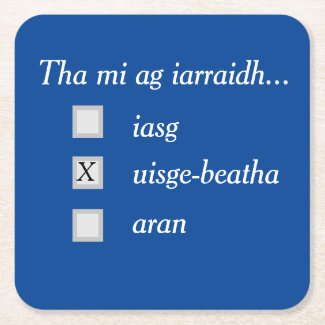
And if you like uisge-beatha:
Where to: North
- falbh (FAHL ahv) to go or go away
- tha e a’ falbh (hah eh ah FAHL ahv) he is going away
- gu tuath (gu TOO uh) toward the north
- dh’falbh e gu tuath (ghahl uhv eh gu TOO uh) He went (headed off) toward the north
Note that falbh can (and often is) written fhalbh or thalla for go away.
Friday’s Phrase
- bhiodh sin uabhasach math (VEE shin oo AH vah sach mah) That would be very good.
NOTES ON PRONUNCIATION:
- I use the underlined CH to show the hard H sound in the back of the throat, such as in the German ich.
- The GH is pronounced with less of a hard G than English would use.
- The EW sound is a softer sound, made with more rounded lips. We really have no English equivalent.
Another fun Scottish-themed gift:

Thursday’s Phrase
- na can guth (nah can goo) don’t mention it
NOTES ON PRONUNCIATION:
- I use the underlined CH to show the hard H sound in the back of the throat, such as in the German ich.
- The GH is pronounced with less of a hard G than English would use.
- The EW sound is a softer sound, made with more rounded lips. We really have no English equivalent.
Wednesday’s Phrase
- a bheil peataichean agad? (ah VALE PET I chin AHK it?) Do you have pets?
NOTES ON PRONUNCIATION:
- I use the underlined CH to show the hard H sound in the back of the throat, such as in the German ich.
- The GH is pronounced with less of a hard G than English would use.
- The EW sound is a softer sound, made with more rounded lips. We really have no English equivalent.
Love to Learn about Scotland: Here’s a blog I came across.
Tuesday’s Phrase
- cia mheud duine cloine a th’ agad? (Ki vewt dinne klewne a HAHK it?) How many children do you have?
NOTES ON PRONUNCIATION:
- I use the underlined CH to show the hard H sound in the back of the throat, such as in the German ich.
- The GH is pronounced with less of a hard G than English would use.
- The EW sound is a softer sound, made with more rounded lips. We really have no English equivalent.
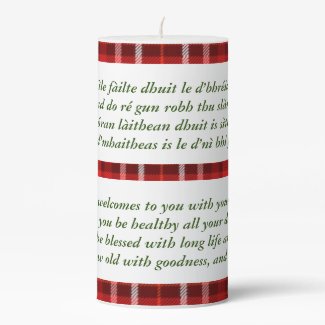
The Scottish Wedding Blessing Pillar Candle:
How was your meal?
Continuing with the question of how was your meal? Yesterday, the dragon’s meal was pretty good. For review:
- Ciamar a bha do bhiadh?
- Bha e blasta
- Bha e fallain
- Bha e ùr
It might also have been:
- Bha e fìor-mhath (VAH eh FYOR mah) It was excellent.
- Bha e fìor-bhlasta (VAH eh FYOR VLAH sta) It was delicious.
- Bha e air leth. (VAH eh air LAY) It was perfect.
Tomorrow: what if you didn’t like the meal so much?
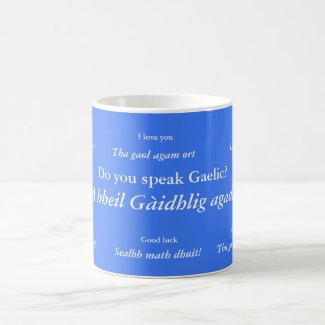
And if you’d like some Gaelic phrases with your meal–here’s a Gaelic/English mug.
Chunnaic mi dràgon ag ithe
… and what was his meal?
Some review from a long ago lesson:
- aran donn brown bread
- caise dearg red cheese
- iasg blasta tasty fish
- ubhal bheag a little apple
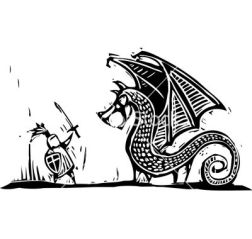
- ridire misneachail!? (ri DEER- uh MIS ni chahl) a brave knight!?
And how was his meal?
- Ciamar a bha do bhiadh? (KIMM ar a VAH doh VEE-ugh?) How was your meal?
- Bha e blasta. It was tasty.
- Bha e fallain. It was healthy.
- Bha e ùr. It was fresh!
If you’d like to hear an old folk story in Scottish Gaelic, here’s a site I haven’t posted in awhile for listening (and reading!) This is a great site: LITIR BHEAG (the little letter)
AN OIDHCHE a BHA A’ SILEADH NA LITE: THE NIGHT IT RAINED PORRIDGE
SEEING … dragons
Oops, it seems I never quite got around to the SEEING part of Seeing and Hearing Dragons yesterday! Here goes, this time without pronunciation since that has been given previously.
- Dè a chunnaic thu?
- Chunnaic mi dràgon
- Chunnaic mi dragon a’ coiseachd (walking)
- Chunnaic mi dràgon ag ithe (eating)
- Chunnaic mi dràgon a’ ruith (running)
- Chunnaic mi dràgon ag iasgach (fishing)
- Chunnaic mi dràgon a’ caoineadh (crying)
And what might the dragon possibly be eating? Check back in previous lessons about food and leave some ideas in the comments, just as a refresher in vocabulary. Iasg? Aran? And what would a dragon be drinking?

 Scottish Gaelic